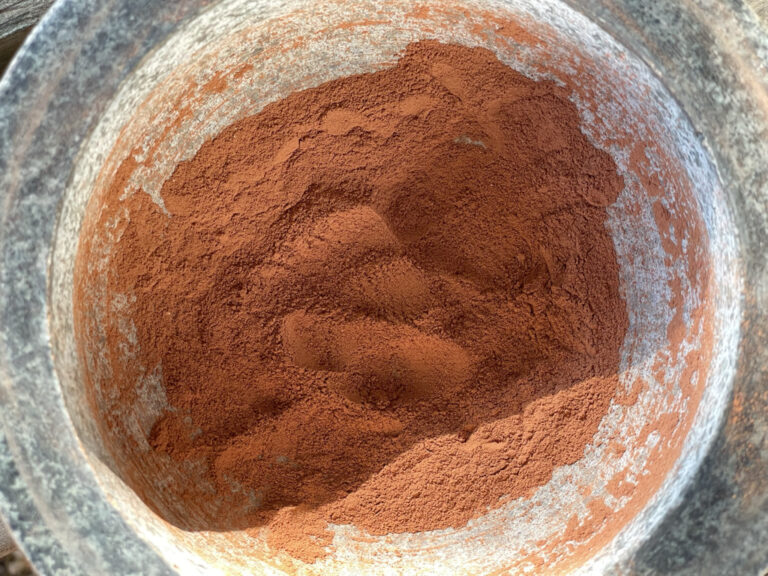
This page explores how natural materials gathered from the site of the image-making — soil, river water, ash, hay, and more — are integrated into my prints. These foraged pigments connect the image to its place of origin, both physically and conceptually.
Where possible, I gather material from the site where I’m photographing or working. That might be a handful of soil, crushed rock, burnt wood, hay from a harvested field, or water drawn directly from a nearby river. These elements are ground, mixed, or rubbed into the surface of the paper — sometimes becoming pigment, sometimes residue, sometimes just memory.
This way of working isn’t about nostalgia or a return to the primitive — it’s about embodiment. The land becomes image. What is photographed is also physically present.
Earth & Soil: Crushed and sieved to produce ochres, umbers, and raw tones
River Water: Used to develop film or dilute solutions — each water source has its own characteristics
Ash & Charcoal: From fire or burned plant matter, used as pigment or texture
Hay, Clay, Wheat: Rubbed into surfaces or added to gum layers for texture and trace
Natural Pigment Binders: Gum arabic, honey, egg, and casein — depending on the material
Pigments are often prepared in small batches using tools I’ve adapted myself. After collecting material from the field, I wash, grind, or boil it depending on what’s needed. The resulting pigments are used with traditional binders or layered into gum bichromate prints, where they interact with hand-coated paper, watercolour pigments, and light-sensitive emulsions.
Sometimes I simply press material into the wet surface of a print. Other times I layer glazes — influenced by the oil painters of the late 15th century — so that the pigment becomes part of the image’s internal logic.
There’s something quiet and slow about this approach. It resists convenience. It requires time. But the prints carry a resonance — a sensory trace of place that’s more than representation.
For me, these processes feel closer to alchemy than photography. They embody the image — its surroundings, its weather, its physical presence.
Fractured Whispers — pigments gathered from the Scottish rainforest
River Chelmer Project — prints developed using river water and embedded field material
A Moment’s Existence — mixed media pieces with layered glazes
This short film documents part of my working process — from collecting site-specific materials to layering pigments and hand-coating paper. Featuring footage from the making of Fractured Whispers and Gwen, it offers a behind-the-scenes view into the tactile, slow-build approach behind the work.
Filmed in the Scottish Celtic Rainforest, 2024. Part of the Studies in Photography feature.
“Fractured Whispers, by Ian Phillips-McLaren is a masterclass in how artists are turning to a slow way of working. Ian pushes this to a remarkable degree.” — Studies in Photography (Journal)
“There’s a moment when the image and the earth become inseparable — not just in subject, but in substance. It’s no longer a photograph of a place; it’s the place itself, held in emulsion, pigment, and time.”
— Ian Phillips-McLaren